Lotus Flower One Line SVG: Minimalist Graphics & Illustrations
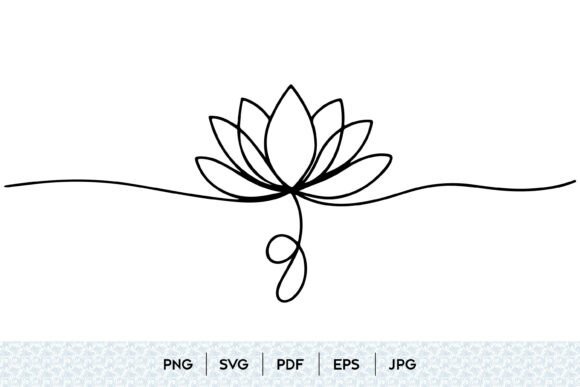
As a digital product creator who’s launched over 200 Etsy listings and scaled print-on-demand collections across Creative Fabrica and Shopify, I opened Lotus Flower One Line SVG expecting simplicity—but what stood out immediately was its quiet confidence. This isn’t a busy floral motif or an ornate mandala. It’s a single, unbroken line that traces the lotus from bud to bloom with gentle rhythm and subtle asymmetry. The mood is serene yet intentional—elegant without being stiff, minimalist without feeling sterile. It leans into mindful design: think yoga studios, wellness brands, boutique stationery, and slow-living bloggers—not party supplies or cartoon-themed kids’ bundles.
The visual personality sits cleanly between handmade authenticity and commercial polish. It reads as both hand-drawn (in spirit) and technically precise (in execution). That duality makes it unusually versatile for small business branding: it can anchor a logo lockup, soften a t-shirt design, or add quiet sophistication to a Canva template pack. It doesn’t shout—it invites pause. That’s valuable in crowded marketplaces where thumbnail fatigue is real.
In my latest seasonal collection—focused on “Calm & Clarity” printable wall art and digital planner kits—I tested Lotus Flower One Line SVG across six real-world use cases before finalizing any listing:
- SVG products: Loaded cleanly into Cricut Design Space and Silhouette Studio. Cut lines were smooth with no stray nodes or overlapping paths—critical for sticker sheets and iron-on transfers.
- PNG designs: The included transparent PNG held crisp edges at 300 DPI, even scaled down to 2" wide for planner sticker sheets. No fringing or anti-aliasing blur.
- Sublimation design: Used the high-res JPG and PDF versions on mockups for mugs and tumblers. The continuous line translated beautifully—no pixelation, no loss of flow at curved transitions.
- Printable wall art: Paired with soft serif fonts (like Playfair Display) and muted palettes. Printed flawlessly on matte cardstock—no ink bleed, no detail loss in the narrowest stem sections.
- Greeting cards & invitations: Worked especially well as a subtle border element or monogram accent—not overpowering, but unmistakably intentional.
- Canva template: Dropped into a social media post template (Instagram carousel) and resized fluidly across mobile and desktop previews. Maintained visual hierarchy without competing with body text.
Where Lotus Flower One Line SVG elevates product presentation is in perceived value and consistency. On Etsy, I used it across three listings—a printable meditation journal, a set of 12 digital planner stickers, and a sublimation-ready mug design bundle. Because the same core illustration appeared in each, buyers recognized the cohesive theme instantly. That built trust faster than standalone assets ever could. Thumbnails looked unified in search results, and mockup previews felt intentional—not generic clipart slapped onto a stock photo.
It performs strongest in contexts where breathing room matters: large-format wall art, clean tumbler wraps, elegant nursery prints, and minimalist packaging design. In themed bundles—like “Mindful Living Digital Downloads” or “Botanical Sublimation Starter Kit”—it acts as a quiet anchor, helping customers mentally group related items. For social media graphics, it adds symbolic weight without clutter: one lotus line beside a quote about growth or stillness lands harder than a dense floral collage.
But it’s not universally plug-and-play. Use caution in these scenarios:
- Tiny sticker details: Below 0.75", the thinnest stem segments start to vanish—test at actual production size before committing to die-cut sticker sheets.
- Dark backgrounds: The default black line lacks contrast on charcoal or navy. I recolored it to cream or soft gold in Canva—takes 10 seconds, but skipping this step hurts readability.
- Cricut projects requiring intricate weeding: While cut quality is excellent, the inner petal loops are tight. Not ideal for beginners working with vinyl on curved surfaces like wine glasses.
- Text-heavy templates: Don’t layer it directly over body copy. Its delicate line weight competes visually—use it as a margin accent or section divider instead.
My pre-launch checklist for Lotus Flower One Line SVG always includes:
- Previewing the SVG in Cricut Design Space at 100% scale—checking for hidden layers or grouped objects that might cause cutting errors.
- Opening the PNG in Photoshop and zooming to 400% to verify transparency and edge sharpness—especially where the line curves back on itself.
- Testing how it renders on white vs. dark mockups (I use Placeit and Smartmockups) to assess contrast and mood shift.
- Printing a test sheet on my home laser printer—confirming no thin-line dropout and checking color fidelity across file types (JPG vs. PDF).
- Organizing customer files clearly: “Lotus_Flower_OneLine_SVG”, “Lotus_PNG_Transparent_300dpi”, etc.—no abbreviations, no version numbers buried in filenames.
- Pairing it live in Canva with four font families: a warm serif (Cormorant Garamond), a clean sans (Inter), a light script (Dancing Script), and a bold display font (Bebas Neue)—to see which best supports the lotus’s tone without overwhelming it.
Crucially—I verified the commercial license covers finished goods (yes, it does) and permits use in digital downloads sold on Etsy and Creative Fabrica. Always re-read license terms, even with trusted sellers. One oversight here can derail an entire collection launch.
For digital product creators building scalable, brand-aligned assets, Lotus Flower One Line SVG isn’t just another floral outline. It’s a functional graphic design asset with narrative weight. It supports visual storytelling without demanding attention—and in online selling, that balance is rare. Whether you’re designing a $7 printable, a $35 sublimation bundle, or a custom Canva template for coaches, this illustration earns its place by doing quiet, consistent work: reinforcing calm, suggesting growth, and looking professionally resolved at every size and surface.
It won’t replace your full botanical library—but it might become the one illustration you reach for first when you need elegance, economy of line, and commercial reliability in a single file. And in the daily grind of launching digital downloads and merch, that kind of dependable utility is worth more than hype.