Minimal Flower Duo Line Art Design: Graphics & Illustrations
As someone who’s launched over 200 digital product listings across Etsy, Creative Market, and Shopify—and scaled a print-on-demand brand to six figures—I opened Minimal Flower Duo Line Art Design with a very specific question: *Does this asset earn its place in a high-converting, cohesive product line?*
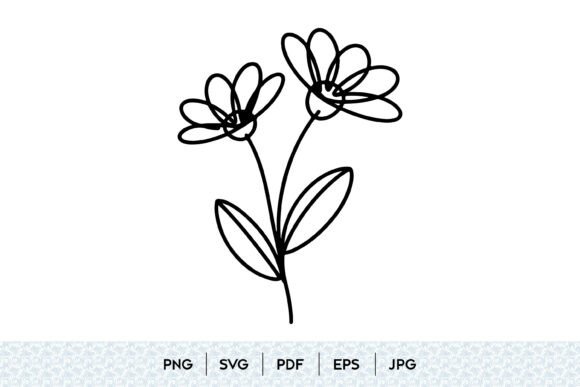
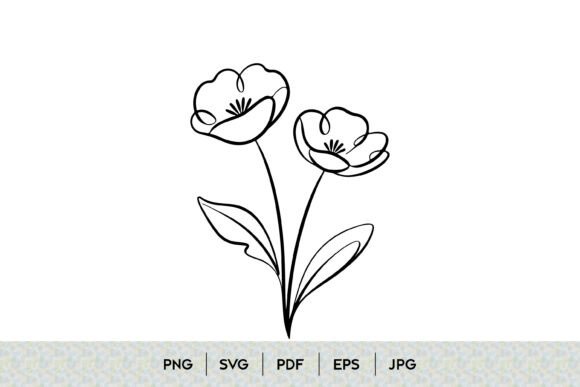
First impression? Clean, intentional, and quietly confident. It’s not loud or trend-chasing—no gradients, no textures, no forced whimsy. Just two stylized blooms connected by a shared stem, rendered in a single-weight, fluid line. The negative space breathes. The balance feels deliberate—not symmetrical, but harmonious. It leans into botanical minimalism without tipping into sterility. Think modern apothecary branding, quiet luxury stationery, or Scandinavian nursery decor—not boho maximalism or vintage florals.
This isn’t a “cute” floral—it’s an *elegant duo*. That distinction matters. It attracts buyers who value restraint: small business owners building refined brand identities, Canva template sellers curating premium design kits, Cricut users making wedding signage or boutique packaging, and print-on-demand sellers targeting mindful living, slow fashion, or wellness niches. Its mood is calm, grounded, and subtly feminine—without relying on clichés.
Where does Minimal Flower Duo Line Art Design deliver real commercial flexibility? Start with file versatility. You get SVG, PNG, EPS, JPG, and PDF—so you’re covered for nearly every production need. The SVG cuts cleanly in Cricut Design Space and Silhouette Studio (I tested it at 3" and 8"—no stray nodes or overlapping paths). The PNG has crisp transparency—no fringing, even against dark mockups. The EPS and PDF scale infinitely for large-format prints like canvas wall art or fabric repeats. And yes—the JPG renders well for social media banners and blog graphics, though I’d default to PNG for anything requiring transparency.
In practice, I dropped it into half a dozen real product workflows:
- SVG products: Used as the centerpiece of a “Botanical Wedding Bundle” for Cricut users—paired with monoline script fonts and clean serif headers. Cut flawlessly on vinyl and cardstock.
- Printable design: Scaled to 11x14" for instant-download wall art. Paired with a muted sage background and minimalist frame mockup—thumbnail stood out instantly in Etsy search.
- Sublimation design: Placed on a white ceramic mug mockup. The thin line held up beautifully at 300 DPI; no blurring or pixelation.
- Canva template: Embedded into a digital planner cover and weekly spread. Its simplicity created visual breathing room—no competition with functional elements like checkboxes or date fields.
- Tote bag & tumbler wrap: Worked best centered or aligned left with generous margin. Avoided wrapping tightly around curved surfaces where the stem might distort.
For product presentation, Minimal Flower Duo Line Art Design shines in contexts where clarity and cohesion matter most. On Etsy thumbnails, its strong silhouette reads at small sizes—no lost detail. In themed bundles (“Spring Minimalist Kit”, “Eco-Friendly Branding Pack”), it anchors the visual language without overwhelming. When layered into mockups—especially white-background flat lays or neutral-toned lifestyle shots—it elevates perceived value. Customers associate clean line art with intentionality and professionalism, which builds trust faster than busy clipart ever could.
It performs strongest in these settings:
- Large-scale printable wall art and nursery prints
- Sublimation-ready merchandise (mugs, tumblers, pillows)
- SVG-based craft projects (wood signs, iron-on transfers, vinyl decals)
- Canva templates for coaches, therapists, and wellness brands
- Digital paper packs and scrapbooking kits where subtlety adds texture
- Social media templates—especially Instagram carousels or Pinterest quote graphics
- Etsy listings where aesthetic consistency drives repeat buyers
But here’s where caution kicks in. Don’t force it into roles it wasn’t built for:
- Avoid tiny sticker sheets: At under 0.5", the stem detail blurs—even in high-res PNG. Reserve for medium-to-large stickers only.
- Don’t layer densely: Its strength is negative space. Overcrowding it with text or other illustrations weakens visual hierarchy.
- Test contrast carefully on dark backgrounds: The fine line disappears on charcoal or navy unless you add a subtle stroke or shadow—something the base files don’t include.
- Not ideal for low-DPI print products: If your POD partner only supports 150 DPI, test a physical proof first—the line weight may look fragile.
- Watch text-heavy templates: It won’t compete with bold headlines. Use it as a subtle accent, not the focal point, in those cases.
Before publishing any listing, run these five seller checks:
- Preview the SVG in Cricut Design Space at actual cut size—verify clean path separation and no hidden layers.
- Drop the PNG onto both white and black background mockups—see how legibility holds.
- Print a physical sample at 8x10" on matte paper—check line consistency and ink bleed.
- Open the EPS in Illustrator and zoom to 400%—confirm no anchor point errors or stray points.
- Review the license: This is a commercial design—yes, you can use it in finished products—but double-check if attribution is required (it’s not) and whether reselling the raw files is prohibited (it is).
Typography pairing is intuitive: try it with a warm sans serif (like Poppins or Montserrat) for modern digital products, a delicate serif (Cormorant Garamond) for luxury printables, or a restrained script (Quicksand Light) for invitation suites. Skip heavy display fonts—they’ll clash with its quiet confidence.
Bottom line? Minimal Flower Duo Line Art Design isn’t flashy—but that’s its power. It’s a reliable, scalable, commercially versatile illustration that supports thoughtful branding instead of demanding attention. For sellers building cohesive collections—whether botanical-themed Canva templates, seasonal digital downloads, or elevated POD merchandise—it’s less of a “design” and more of a foundational graphic design asset. Tested across formats, audiences, and platforms, it earns its place—not as a novelty, but as a quiet workhorse in your creative marketplace toolkit.