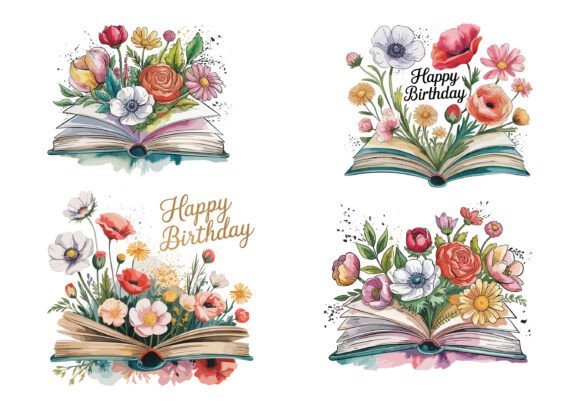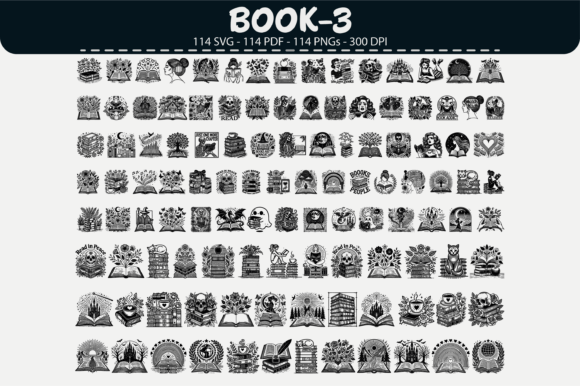
Book Clipart Bundle – 114 Designs
A Designer’s First Look: Whimsy, Clarity, and Quiet Confidence
Opening Book Clipart Bundle – 114 Designs feels like stepping into a well-organized studio library—no clutter, no visual noise. These aren’t overly busy illustrations or cartoonish caricatures. Instead, they’re clean, purposeful, and quietly expressive: open hardcovers with subtle spine texture, stacked paperbacks with gentle shadowing, vintage reading glasses perched on a novel, even tiny bookmarks and inkwells rendered with thoughtful negative space. As an embroidery designer who’s stitched everything from nursery pillows to boutique aprons, I immediately sensed their adaptability—not just as graphics, but as stitchable ideas.
Real Project Test: Embroidering a Personalized Tote for a Local Bookstore Pop-Up
Last week, I prepped a custom tote bag for a neighborhood indie bookstore’s summer launch. They wanted something warm, literary, and unmistakably handmade—not clip art slapped on fabric. I chose one of the simpler designs from the bundle: a soft-lined stack of three books with a single ribbon accent. Why? Because it held up at 3.5" wide in my hoop, translated cleanly into satin stitch for spines and fill stitch for covers, and left breathing room for thread texture to shine. Customers didn’t just see “a book”—they paused, smiled, and said, “That looks like *my* shelf.” That’s the quiet power of this bundle: it supports storytelling, not just decoration.
Where It Shines (and Where It Asks for Thought)
Book Clipart Bundle – 114 Designs excels in projects where charm meets clarity:
- Embroidered patches — Clean outlines and moderate detail hold up beautifully when cut and sewn onto denim jackets or backpacks.
- Baby embroidery — Gentle shapes (like a curled-up bookworm or a sleeping owl beside an open storybook) avoid sharp angles or tiny features that could snag or distort on onesies.
- Tote bag design and sweatshirt embroidery — Medium-scale motifs scale well without losing legibility; many fit comfortably in a 4"x4" hoop, ideal for small-batch production.
- Holiday embroidery and personalized gifts — A wrapped book with a bow or a snow-dusted title page reads instantly as thoughtful, not generic.
- Craft business branding — Use one of the minimalist book icons as a subtle watermark on printable mockups or digital product previews—it reinforces niche identity without shouting.
Design Notes for Real Embroidery Work
This isn’t just about dropping a file into your machine. Here’s what I checked before stitching:
- Test on scrap fabric first — Especially for textured fabrics like canvas tote bags or looped terry kitchen towels. Some delicate line work (like thin pages or fine script titles) needs light stabilizer support to prevent puckering.
- Review stitch density — Not all 114 designs are equal in fill area. The denser compositions (e.g., a full bookshelf scene) benefit from reduced underlay or a tear-away + cut-away hybrid stabilizer on lightweight cotton.
- Confirm hoop size early — Several designs expand gracefully to 5"x7", but the most versatile for small shops are those that live comfortably in 3"x3" or 4"x4". Scan the PNG previews at actual size—you’ll spot which ones need simplification for caps or curved surfaces.
- Inspect small details — Tiny elements like eyeglasses’ hinges or bookmark tassels may vanish if shrunk below 2". If you’re making baby embroidery or embroidered patches under 2.5", prioritize bolder silhouettes from the set.
- Check thread color contrast — These designs rely on shape, not heavy outlines. On dark fabric, a light thread (ecru, soft grey, or cream) reads better than stark white. Always test a color combo in natural light.
Fabric & Function: What to Keep in Mind
For custom apparel like sweatshirts or stretchy tees, lean into the bolder, more graphic entries—think a single bold cover with strong silhouette and minimal interior lines. Avoid high-detail scenes here; they’ll lose definition in knit fabric movement. On thin fabrics like linen tea towels, use a light cut-away stabilizer and reduce top tension slightly—the clean vector lines translate well, but delicate stems or thin spines need support. For layered garments (like reversible aprons), choose symmetrical or centered layouts—they balance visually and stitch more evenly across seams.
Why This Bundle Builds Trust—Not Just Inventory
As an Etsy seller and small shop owner, I know customers don’t buy clip art. They buy intention. When a customer sees a hand-stitched book motif on a gift pillow—clean, balanced, and clearly designed *for embroidery*, not just adapted—it signals care. That lifts perceived value. It also strengthens brand consistency: whether you’re selling nursery decor, teacher appreciation gifts, or boutique stationery, Book Clipart Bundle – 114 Designs offers cohesive visual language across products. No mismatched fonts or inconsistent line weights. Just quiet professionalism—something buyers feel, even if they can’t name it.
A Final Note for Commercial Use
This is a digital embroidery file collection—114 SVG, PNG, and PDF files—all delivered instantly. Since no physical product ships, success depends entirely on how thoughtfully you apply it. Before listing finished products on Etsy or launching a craft fair line, confirm licensing terms directly with the creator. Some bundles allow unlimited commercial use of stitched items; others restrict resale of digital files or require attribution. When in doubt, treat it like any other design asset: verify, test, and tailor—not assume.
Bottom Line for Makers
If you embroider personalized gifts, run a craft business, or design small-batch apparel, Book Clipart Bundle – 114 Designs isn’t filler—it’s functional inspiration. It bridges illustration and stitch with intelligence and restraint. It doesn’t shout. It invites. And in a market flooded with overdesigned graphics, that kind of quiet clarity? That’s what makes a handmade product feel truly seen.